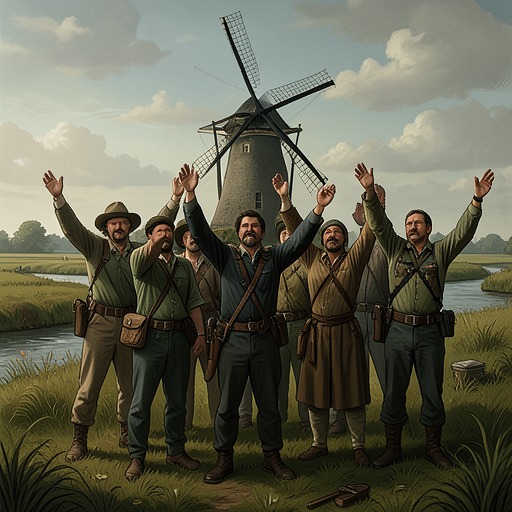
Lambert van Mounen
Hans Brinker, or The Silver SkatesLambert van Mounen is a Dutch schoolboy, skater, and friend to Benjamin Dobbs whose part in the skating journey joins local knowledge to cross-cultural fellowship. He helps Ben find his footing among the Dutch boys, shares the history and sights of their country, and proves both a determined companion on the ice and, in the later account of the group, a man who has built a thriving life in America.
Identity and Introduction
Lambert is among the boys gathered around Jacob Poot when Jacob introduces his English cousin, Benjamin Dobbs. The narrator explains that the conversation is being translated and its speakers’ imperfect attempts at one another’s languages are being regularized for the reader. That qualification matters to Lambert’s introduction: he belongs to a group whose words and customs Ben must gradually learn, but he is also one of the boys who makes that contact welcoming. Ben soon feels that skating has made the group familiar to him even where speech remains a barrier.
The boys’ first exchange establishes both the comic difficulty and the promise of their meeting. Ben’s Dutch phrasebook offers vocabulary without the ability to form a useful conversation, while the Dutch boys hesitate to speak the English they have studied. Lambert is among those who nevertheless communicate with Ben in English. Rather than making linguistic fluency a condition of friendship, their shared skating gives them a common activity from which familiarity can grow.
A Guide to Dutch Places and History
During the visit to Amsterdam, Lambert offers to show Ben the City Hall if the party has time. He explains that the building stands on nearly fourteen thousand piles driven seventy feet into the ground, then directs Ben’s attention to a painting of Van Speyk blowing up his ship rather than surrendering it to the enemy. Ben has not heard the story, so Lambert supplies the essential circumstances: Van Speyk faced capture during an engagement with the Belgians and destroyed both his ship and himself rather than yield. The exchange shows Lambert acting as an informal guide, introducing a visitor to Dutch history through a particular monument and the story attached to it.
Lambert also joins the boys’ conversation about Ben’s surprising knowledge of Holland. Ludwig van Holp is taken aback by how much Ben seems to know and urges Lambert to tell him about tulips, expecting that subject to put the English boy at a disadvantage. Instead, Ben recognizes the reference to the Tulip Mania and asks about its history. The moment reverses the expected roles: the Dutch boys are not simply instructing an uninformed visitor, and Lambert’s suggestion becomes an opening for the group to discover how much their guest has already read.
The city itself gives Lambert and Ben another subject to share. Ben admires Amsterdam’s broad semicircular avenues, canals, paved roads, and clean streets, describing the impression to Lambert as one of petrified neatness. Lambert is therefore a listener as well as a local informant: the excursion brings Dutch places into view through Ben’s responses, not only through explanations supplied by the Dutch boys.
The Skating Journey
On the canal, Lambert takes part in the journey’s everyday negotiations as well as its sightseeing. When he observes that Ben’s English blood makes him cold while the Dutch skaters are comfortable, he calls to Peter van Holp about stopping at a farmhouse to warm their toes. Peter turns to ask who is cold, and Lambert identifies Ben. The episode is light in tone, but it shows Lambert attending to his friend’s discomfort and making room for it within the group’s brisk, physically demanding outing.
The party’s shared arrangements also expose Lambert to the consequences of collective decisions. Jacob explains that the boys first agreed to put their purses into Peter’s keeping. When the group is left hungry, Jacob apologizes to Ben for proposing that arrangement. Ben reassures him that he meant well, and the narrator notes that the other boys, including the Van Holps and Carl Schummel, take Ben’s cheerful manner to mean that he has found a plan to help them. The evidence does not specify a separate remedy from Lambert, but his place in the scene is as one of the companions caught up in the group’s common predicament and reliance on one another.
The prospect of continuing the long return journey tests Lambert’s stamina and his sense of shared achievement. As the boys consider whether to rest in Leiden or go on, he and Ludwig look anxious and disappointed at the thought of losing credit for skating all the way from Broek to The Hague and back. They nevertheless agree that Jacob should decide, since he started the excursion. Jacob says that his suggestion to stop was a joke and that they will skate on. Lambert’s response registers both the exhaustion of the expedition and the value the boys place on completing it together.
Later, the narrator describes the party moving at great speed along a canal. Jacob, Ludwig, Lambert, and Carl each slacken before Peter and Ben, who continue racing in the distance. Lambert is among the first to recognize that the two leaders will not stop until forced to do so. His participation in the race is therefore not only a matter of speed: he watches the contest closely and understands the stubborn resolve driving his companions onward.
Friendship, Competition, and Historical Memory
Lambert’s friendship with Ben develops through a combination of translation, teasing, and shared interests. He speaks English with him during the tour, interprets local matters when needed, and joins the jokes that keep the boys’ different habits from becoming a serious divide. When Ben’s enthusiasm for Dutch history threatens to turn into loud cheering in Leiden, Lambert playfully covers his mouth to quiet him. Ben later explains the interruption to Jacob as Lambert’s attempt to prevent an English riot in the orderly town. The small comic intervention conveys their ease with one another: Lambert can restrain Ben’s exuberance without interrupting the underlying friendship.
Their historical conversation also turns toward the Sieges of Leiden and Haarlem. Ben tells Lambert that he wants to see the carrier pigeons associated with Leiden’s relief, recalling how messages were carried during the siege and how the rising waters allowed Dutch boats to bring men and provisions to the city. Lambert replies that the pigeons can be seen in the same building as Van der Werf’s portrait, then asks which siege Ben considers the greater defense. Ben favors Haarlem’s resistance, while explaining that it also gave the people of Leiden an example of courage and endurance. Lambert’s question makes history a subject of exchange rather than a lecture: Ben brings his reading, Lambert supplies a local point of reference, and their conversation connects the two sieges.
At the great skating race, Lambert begins among the three boys abreast with Hans Brinker and Peter. Carl breaks past them, and Lambert starts to flag while Hans and Peter remain strong. The crowd’s attention settles on the two boys who continue to contest the lead; Peter ultimately wins the one-mile race. Lambert’s place in this passage is that of a competitor whose effort helps form the race’s changing front, even though the finish belongs to Peter. His participation ties the schoolboy journey to the larger public competition without making him its victor.
Later Life and Retrospective Significance
The closing account of the friends reveals that Lambert has become a thriving citizen and lives in New York, with his home not far from Central Park. He compares the park’s prospects with the beautiful woodland near The Hague, hoping that New Yorkers will care for it well enough for it to equal the landscape he remembers. The comparison carries his Dutch experience into his new surroundings: the park is measured against a place that remains part of his memory, even as he imagines the American city shaping its own version of it.
Lambert also remembers Katrinka Flack, who rejected him when they were young. The narrator says that he is now glad she sent him away, because Ben’s sister Jenny has made him happier than he could have been with anyone else. The later account thus revises the meaning of an earlier disappointment: what seemed at the time to be Lambert’s darkest hour no longer appears to him as a lost future. His adult contentment is not achieved by recovering the affection he once hoped for, but through a different relationship that the narrator presents as more fitting.
This retrospective gives Lambert an arc beyond the skating adventure. As a boy, he is defined by movement among friends, places, and languages; as an adult, he remains connected to the Dutch landscape while making a successful life in America. His part in the novel is supporting rather than central, but his trajectory gives the excursion lasting consequence: its friendships and youthful disappointments belong to a past that the characters carry into lives changed by time.